
Notes to my child

Why I may never send my kids to school

Three seismic forces are reshaping the modern world, altering not only our societies but also the futures of our children. These shifts—political, technological, and emotional—demand that we rethink how we live, work, and raise the next generation.

1. The Age of Certain Uncertainty

The world is becoming increasingly unpredictable and protectionist. Much of this shift stems from the rise of leaders who govern through personal vendettas and act on conspiracy theories driven by the “viral” culture on social media. The lines between truth and falsehood are increasingly blurred. In the new world, where any action can be deemed harmful depending on who wields power, becoming positively invisible is a kind of a superpower.

Deep thinking itself is becoming rare. Science has been pushed to the margins, replaced by spectacle and noise. Reading—once the quiet foundation of informed societies—is also in decline. As data journalist David Montgomery notes in his analysis, “just over half of all Americans said they read at least one book in 2023,” and of those, an overwhelming 82% read ten or fewer. These are shocking numbers that show deep, sustained engagement with ideas is rapidly disappearing. Similar trends can be observed in other parts of the world.

My point is, that as humans, we are prioritizing surface level understanding driven by byte-sized dopamine-laced information over in-depth understanding.

2. The AI Moment

Artificial intelligence (AI) is transforming the very way we think about our education and work. As our capacity for deep engagement diminishes, the rise of AI adds another layer of disruption—challenging not just what we learn, but how we learn. For example: with AI’s advent, no longer do we need to polish our handwriting skills (remember the handwriting competitions that used to happen in schools?) or our typing skills (the typing speed tests?) on a computer.

The challenge is no longer about rote skills but about asking the right questions, synthesizing knowledge, and shaping work that feels meaningful to each individual. All of this requires critical thinking about who we are, what we want in life, and what makes our lives meaningful.

Crucially, education and work are no longer bound to a single location; they can flow from anywhere, as long as we bring creativity and purpose to it.

3. A Pandemic of Loneliness

Despite unprecedented global connectivity, people are lonelier than ever. In their groundbreaking book “The Good Life: Lessons from the World’s Longest Scientific Study of Happiness”, researchers from Harvard’s Study of Adult Development report that about one in four Americans—over sixty million people—say they feel lonely. According to the book, the problem is not confined to the United States. In China, loneliness among older adults has surged in recent years, while in Great Britain the crisis has grown so acute that the government has appointed a “minister of loneliness.” The Longitudinal Ageing Study in India (LASI)—surveying nearly 72,000 adults aged 45 and older—found that 20.5% reported feeling moderate loneliness, while 13.3% experienced severe loneliness.

The new paradox of our age is that while technology promises us to connect with people and make our lives easy, we are feeling more isolated within ourselves. Loneliness, left unaddressed, drains life of its meaning. The recent experience of Covid has also made individuals wonder about their priorities in life with more people wanting to spend time with their loved ones.

Schools in the Shadow of These Shifts

Under the umbrella of these sweeping changes, I wonder how do we raise our children to become thoughtful, kind, resilient and happy individuals capable of leading good and meaningful lives? Increasingly, I wonder if sending them to schools—at least as they currently exist—is the right choice.

Most of us know that the modern school system is, in many ways, a relic of the British-led Industrial Revolution. Its structure— rows of desks, bells that mimic factory whistles, standardized curricula, over-emphasis on English language—was designed to produce compliant thinking in students. But the world of tomorrow does not need compliant workers; it needs independent thinkers, creative builders, and empathetic humans.

Encouragingly, some countries are beginning to recognize this. India’s National Education Policy 2020, for instance, calls for a shift away from rote memorization toward play-based learning, conceptual understanding, and exposure to diverse languages and experiences. It’s a step toward reimagining schools as places that nurture curiosity and creativity rather than conformity—though the gap between policy and practice remains.

Schools today are also starting to overindulge in digital tools without teaching children how to counter their ill-effects. Instead of protecting kids from distraction, they amplify it. Teachers distracted by phones, lessons funneled through screens, and students scrolling endlessly erode the very capacities our children need most: concentration, patience, and long-form reasoning.

As one recent New York Times essay put it, the smartphone has become a direct assault on literacy, democracy, and our ability to think clearly. Documentaries like Adolescence on Netflix highlight just how devastating digital overexposure can be while schools remain ill-equipped to shield them.

Defining a Good Life

Every time I reflect on these issues (mostly with my wife), we arrive at an unsettling conclusion: perhaps sending our future children to schools, as they currently exist, may not be the best choice.

At the heart of this reflection, pressed against the changes in the current world, is our own definition of a good life—one we wish to pass on to our children. For me, it has three components.

First, relationships. Decades of research confirm that good relationships—with family, friends, spouses, and even colleagues—are the single strongest predictor of happiness and well-being (for more, read The Good Life). While schools predominately focus on reading, writing, and giving subject-matter knowledge, they rarely teach the art of building and sustaining relationships.

In fact, I wonder: since educated parents already take responsibility for giving their children the knowledge and skills they need, and now have tools like AI to help, why should kids still have to sit in rigid classrooms away from their parents, siblings or grandparents? Parents who are busy or less educated may still need schools to teach their kids, but today there’s little reason for educated parents to do the same if they have the time and resources – both human and monetary.

Also, if Covid taught us anything, it is that time with our loved ones is finite and precious. I want our children to grow up experiencing family not as something squeezed into evenings and weekends, but as a central pillar of their lives.

One can argue that schools are where children socialize and make friends for lifetime. There is merit in this argument. However, in today’s world, children can still make friends outside traditional schools—through smaller, interest-driven communities that foster deeper bonds. They can participate in smaller group activities aligned with their deep interests at time and place of their choosing.

Imagine a child beginning the day in meditation with peers, playing football or tennis in the afternoon, and ending with a book discussion with another set of friends. Now imagine the next day where the child decides to spend the entire day with their grandparents reading books. Such interest-driven communities and choices build agency, decision-making, and collaboration—qualities schools often replace with competition and comparison.

Second, if relationships anchor happiness, meaningful work anchors purpose. With AI and robotics taking over much of the routine labor, what remains for humans is the pursuit of purpose. Our children will need to do the work they love—work that not only sustains them but also contributes something positive to the world.

Schools, however, are still preparing students for industries of the past, where conformity and compliance mattered more than creativity and passion. To identify and do meaningful work, what is needed is self-reflection and self-understanding of the highest order. As kids remain outside the ambit of the traditional schools, they have a better chance of developing these higher order tools.

Third, the power of digital invisibility. A recent estimate shows that people worldwide are spending more than six hours every day on screens. And that spending time online makes us feel more anxious, fearful and lonely. Factor in eight hours of required sleep and another eight of obligatory work or schooling, and what remains is a mere two hours a day—just one-twelfth of our lives—for reflection, relationships, and meaning – things that make a good life.

To spend nearly 90% of our waking life in distraction and compliance is to squander life itself.

Personally, I do not want my children to spend six hours a day exposed to digital devices that make them anxiously visible to the world and vulnerable for manipulation. And unless today’s schools truly change and realign towards helping children lead a good life, I do not want our children to spend another eight hours of their youth training to be compliant workers.

Instead, I want them to spend those fourteen hours with family, with friends, with books, and with themselves. I want them to become invisible to the noise of the world so that they may be visible in the lives of those who truly love them.

I would rather raise children who are fully alive than children who are merely schooled. And that is why I may never send mine to a school.

Standard
Notes to my child

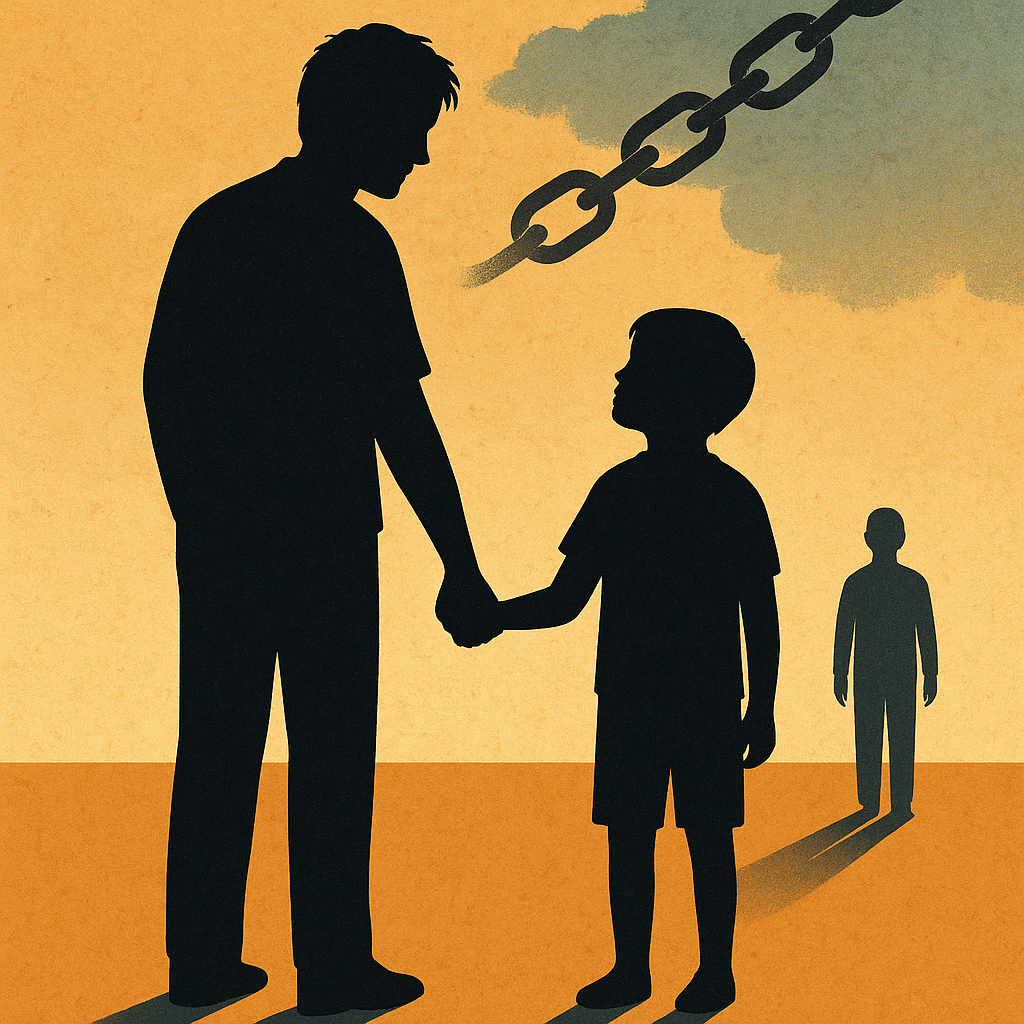
Fear Is Learned — And We Can Choose Not to Pass it on

One sunny afternoon, as my wife was working on one of her academic papers, she told me she had been feeling fearful — of the writing process, and of the feedback she might receive from her guide and the scientific community. When I asked why she felt this way despite being well prepared, she admitted that, even now, she sometimes experiences the same fears she had as a child. It wasn’t failure she was afraid of, but the possibility of not producing a paper that was perfect.

Many of the fears we carry into adulthood are not entirely our own. They are echoes — internalized through childhood experiences, social environments, and often, the unspoken anxieties of those who raised us. Psychological research shows that fear responses are not purely innate; they are also socially learned and transmitted across generations (Gerull & Rapee, 2002).

Her story reflects this truth: fears from childhood often remain embedded in adulthood and if not acted upon can be traversed to our next generation i.e. our kids.

These fears can emerge from multiple sources –

  1. Direct and deep personal experiences (e.g., repeated punishment, ridicule) as a child;

  2. Socio-economic circumstances (e.g., scarcity, instability);

  3. Educational environment (e.g., high-stakes grading, unsupportive teachers);

One of the most common ways children internalize fears is through parental modeling — observing and adopting their parents’ anxieties. I will focus primarily on this aspect in this piece.

This is part of a writing series I am calling “Notes to my child” where I am trying to document my thoughts and strategies of raising my future kids and sharing these with my co-travelers.

Positive vs Negative Fear

Let me also clarify that no parents actively try to make their children fearful or pick up their anxieties. In fact, it’s the exact opposite. Both as current or future parents, it’s important that we raise our children without unnecessary fear. This is harder to do than it sounds.

Positive fear is necessary. It helps a child survive in this world. It ensures that they don’t poke their fingers inside the electric switch board or stand, smiling, in front of a pouncing lion.

While positive fear can be considered as a built-in alarm system”, the negative fear is a built-out, overactive alarm system”. It goes off even when there’s no real danger.

A Thought Experiment: Three Parenting Advice

How does this negative fear get transferred from parents to children then?
Let’s try to understand this with the help of a thought experiment:

Imagine a ten-year old child who has been asked to speak in a school assembly on the topic of “cleanliness”. The child comes home and tell this to his parents. The parents help prepare him a paragraph on the topic and asks him to practice.

Imagine this child being raised by three different set of parents: Parents 1, 2, and 3. Each set of parent gives different set of instructions and/or set different expectations for their child.

Parent 1:You have to make sure that you remember everything by heart and don’t forget anything while you speak. It has to be perfect and according to what we taught you. Remember practice makes a man perfect! The way you perform in pressure situations will indicate how well you will do later in similar situations in life.”

Parent 2: It’s good that you remember everything and we hope that you will be able to speak what you have prepared. It might happen that you forget a few things while on stage but you should remember the overall message on cleanliness that you want to convey! Good luck!

Parent 3: We don’t think that you need to prepare anything for such a simple topic or that you need any help from us. Just go and speak what you think comes to your mind. Just remember to not say anything stupid. Anyway, we don’t have much time to give.

Now, the next day, the child performance, on a parameter of 100% perfection was, lets say, 80%. He forgets something during their speech but manage to put up with the task. How do you imagine Parent 1, 2 and 3 to react? I believe it will be something like this –

Parent 1: “You forgot the last line we practiced! We told you exactly how to say it. You need to prepare more seriously next time — mistakes like this can be avoided.”

I will call this type of response as a “Perfection-Driven Response. Research says that, for example, “fathers of high socially anxious children exhibited more controlling behaviors. (Flett et al., 2002).”

Parent 2:
“You spoke well! You missed a few points, but you got the message across — that’s what matters. Next time, you can add those points too.”

I will call this type of response as a “Encouragement-Centered Response.” Research says that Growth-oriented feedback fosters resilience and intrinsic motivation. Carol Dweck’s work in this regard is path-breaking where she speaks on growth vs fixed mindset.

Parent 3:
“At least you didn’t embarrass yourself. See? It wasn’t that big a deal.”

I will call this type of response as a “Hands-Off Response.” Research says that emotional neglect or low parental engagement can reduce self-efficacy and ambition.

What do you think were the child’s takeaways from each parent’s responses and how these takeaways would echo in children’s adult life?

Here’s my take –

Breaking the Cycle

Objectively speaking, each child received same results. But it received different reactions by parents resulting into starkly different takeaways by the child. These takeaways, and many such similar experiences through parental interactions, starts to define a child’s personality including their anxieties and fears.

Breaking this cycle of inherited fear requires conscious, consistent effort as an adult. This becomes even more critical if as parents we want our children to lead lives without any kind of negative fears.

Some strategies include (but not limited to):

  1. Self-Awareness First – As adults, we should start by identifying our own learned fears before addressing them with children. Activities such as reflective journaling, therapy, and mindfulness can help uncover inherited anxiety patterns.

  2. Modeling Self-Compassion – Most of the time, adults are too hard on themselves and they forget to treat themselves with self-compassion. It’s important that adults treat both their and children’s errors as learning opportunities rather than proof of inadequacy. Modeling self-compassion in front of children reduces their fear of failure.

  3. Encourage Process Over Perfection – Praise effort, strategies, and persistence instead of flawless outcomes.

  4. Provide Emotional Safety – Create environments where children feel safe to try, fail, and try again without ridicule or disproportionate punishment.

  5. Educate on Fear Itself – Teach children the biological purpose of fear and how to distinguish between positive fear (real danger) and negative fear (false alarms).

We can’t shield children from all fear — nor should we. But we can prevent unnecessary fears from taking root. That means being mindful of the lessons we give, both in words and in the silences between them. By practicing these habits, we reduce the risk of passing on our own fears and anxieties — giving children the space to develop confidence, adaptability, and a healthy relationship with imperfection.

Whenever my wife finally submits her paper, I hope that she smiles and says, ‘It’s not perfect — but it’s done.’ The courage she will learn is the courage that I’d want our children to inherit.

References

Gerull, F. C., & Rapee, R. M. (2002). Mother knows best: Effects of maternal modeling on the acquisition of fear and avoidance behaviour in toddlers. Behaviour Research and Therapy. https://doi.org/10.1016/S0005-7967(01)00013-4

Flett, G. L., Hewitt, P. L., Oliver, J. M., & Macdonald, S. (2002). Perfectionism in children and their parents: Associations with depression, anxiety, and everyday distress. Journal of Psychopathology and Behavioral Assessment.
https://doi.org/10.1023/A:1020779000183

Dweck, C. S. (2006). Mindset: The new psychology of success. New York, NY: Random House.

Standard
Two parents, likely Indian origin, holds hands of their two young children.
Notes to my child, Philosophy

The Kind of Love That Raises Us—and the Kind We Choose to Give

We don’t usually internalize this but, I think, we are, for most part, exactly like our parents. The debate between nature vs nurture in playing a pivotal role in building our adult personalities is an old one. Earlier, during my twenties, I had a firm belief that nature dominates over nurture. This belief, however, has now shifted entirely — I now feel that nurture matters far more.

This shift came from learning how children actually learn (my education at Harvard helped). It is also connected to my education in scientific concepts like the evolutionary history of the homo sapiens as species. Understanding how we are brought up during our childhood opens up opportunities to understand who we are today. It’s also the key to making ourselves overcome certain limitations our upbringing may have brought to us. Understanding our childhood is the first step in overcoming these limitations.

This raises the question: what’s the key to a good nurturing in childhood?

I think the prominent answer to that lies in love. If a child receives love from their parents, or from a “concerned adult”, it creates a powerful sense of stability in children. This feeling of stability extends well into adulthood.

A lack of love between parents often becomes visible in a child’s upbringing. It can make a child feel very insecure or afraid. Continuous fighting between parents can also cause insecurity in a child. This insecurity may well extend into adulthood. In cases when one parent is missing, the other parent’s role becomes even more crucial. They must ensure their child gets unbiased love from them. I refer to this love as “positive love”. It’s the kind of love you’d expect Harry Potter’s parents to give to him. It’s the kind of love that makes you brave, courageous, kind, unafraid of failure, and empathetic to others.

Then, there’s also the kind of love we may refer to as “non-positive love”. A good example of that love is what Harry’s cousin Dudley or Harry’s nemesis, Draco Malfoy, received. Though unconditional, this kind of love had made both Dudley and Malfoy deeply insecure, turning them into bullies. It made them consistently compare with others, and nudged them to harm Harry at every opportunity they got. It’s the kind of love that makes anyone a coward, cruel, rude, clingy, selfish, jealous, and afraid of failure.

Few traits of Positive loveTraits of Non-positive love
Mostly driven by love between parents /concerned adultMostly driven by loss of love between parents; fighting/bickering between parents/concerned adult
Children don’t often compare themselves with other children Children compare themselves with others, primarily driven by parents need of comparison or fear
Children are not afraid of failure because they know they can fall back on their parents; parents encourage failure as a positive learning experienceFailure is considered a reflection of parent’s report on their parenting; children feel failure is the end of the world; they hesitate in feeling dependent on their parents
Mostly make children kind, secure, brave, and empathetic to others Mostly make children cruel, clingy, and show lack of empathy to others
The kind of love we believe Harry Potter’s parents would have given him if they were alive The kind love given to Dudley, Harry’s cousin; or to Draco Malfoy, Harry’s nemesis at Hogwarts
Kinds of love that children get from parents/concerned adults


There’s a third kind of love too which is nothing but the “absence of love”. Under this condition, the child often feels conflicted with the concept of love itself. Having no sense of what that feeling is, they feel disconnected with their surroundings. A feeling of emptiness, or in some cases, abandonment takes over.

In Harry’s case, after he went to Hogwarts, he understood that he was loved by his parents. He realized this even though they were dead. He understood that love can be felt even when the person is not there with you anymore. The “absence of love” happens when, despite the presence of the parents/concerned adult, the child doesn’t get love.

As children grow old, they also fall into one of these categories as adults. This happens because of the intimate experience of going through it with their parents or a concerned adult. In a way, the children turn into their parents.

This categorization sticks through our adult life unless we take concerted efforts to understand our upbringing and make efforts to transform us into “positive lovers”. The natural categorization influences us to reflect positive, non-positive or absence of love in almost all aspects of our lives. This includes who we date and marry, and what career we choose. Most importantly, it involves how we raise our own children (if we choose to have them).

But what’s the process of becoming a “positive lover”? In my opinion, it has three steps to it:

  1. Analyze and acknowledge the kind of love we received in our childhood. It is important to be non-judgmental to our parents/concerned adult while doing this exercise.
  2. Determine our current category (positive, non-positive, or absent) as an adult.
  3. Identify concrete actions/steps towards becoming a positive lover. Writing these steps are helpful.

The third step is crucial because it will determine the type of children we will raise. The children we will raise is directly based on the type of adult we are while raising them. Personally, for me, having the idea of children excites me. Many of my friends and I are at a stage where we are planning to have kids. Some of us already have them. For my future children, I want to make sure that I provide them with “positive love”.

Of late, I have realized that parenting is probably one of the most powerful tools for self-transformation too. When we will choose to parent differently — with more awareness, empathy, and intention — I believe that we will start to heal parts of ourselves we didn’t even know were wounded. We will begin to notice patterns in our own behaviors that once went unquestioned. We will pause before reacting, will listen more closely, and will try to give our children the kind of love we may have missed.

Of course, none of this could happen without taking the first step in acknowledging that our behaviors as an adult are a reflection of our upbringing. Accepting that is in itself a daunting task. By choosing to acknowledge it and raising our children on the foundation of “positive love” , we aren’t just shaping our children’s lives — we are also reshaping our own. Parenting, in that sense, isn’t just an act of giving. It’s also a process of becoming. We get a second chance at childhood through the eyes of our kids. And in that second chance lies the possibility of deep, lasting change.

Understanding the kind of love we received as children isn’t just about looking back — it’s about taking charge of who we become. Whether we grew up with positive love, non-positive love, or the absence of it, we always have the power to rewrite our story – and in turn, writing the story of our children’s lives.

Standard
Philosophy

The Money-Relationship Framework of Happiness

What matters most to humans at an individual level? Is it money, relationships, or a combination of two which we sometimes refer to as “happiness”?

Money * Quality of Relationships = Happiness ?

For many years of my life, I have closely observed what it feels like to be living in the state of feeling that you lack something, especially money. When I was a kid, money did not come easily for my family. My father, who was a highly successful civil engineer did not save much before he passed away in an accident. The immediate years after his demise forced us to live a life of constraint. As a kid, you don’t really feel these things. This is especially true when you have a loving adult in your life. Friends also make a big difference. In my case, I had both. My mother and sister loved me unconditionally and gave me a life of stability. I had amazing friends with whom I shared my life. In a way, for most of the time in my childhood, I felt happy because of the quality of relationships I had. These relationships made me believe that I wasn’t lacking anything important.

When I was a KIDMoneyQuality of relationshipHappiness
High ~~~~
Low~~
Extremely low
Money-relationship framework when I was a kid

On the other hand, I saw poverty – the absolute lack of money – firsthand when I started telling stories to children in the villages of Bihar, Uttar Pradesh, and Rajasthan in India. It is here that I observed closely the daily lives of hundreds of kids who chose to come to school more for a promise of a free meal than for the love of learning. The quality of relationships didn’t matter because the lack of financial means made their day-to-day survival extremely challenging. It is my understanding that they lacked what I as a kid felt as “happiness”. The frame of reference for these kids having extremely low money made for low happiness in their lives, irrespective of the quality of relationships they had. Sadly, for lakhs of kids, that’s how their lives are even today.

Poor kids in rural IndiaMoneyQuality of relationshipHappiness
High Irrelevant
LowIrrelevant~~
Extremely low ~~Irrelevant
Money-relationship framework for many kids in rural India

My assumption is that the readers of this written piece would not be in the zone of what is referred to as the phase of “extremely low money” where quality of relationships is irrelevant to the level of happiness they feel. In fact, the quality of relationships are what matters the most to how happy or sad, you, my reader must feel.

If I consider my life today, I think the quality of relationships I have plays a prominent role in determining my happiness. Money, yes, does play its role but for me it is something that helps me to not consistently think about how to earn it. Having “enough” of it makes me believe that I can do things that I really enjoy doing and to not fear about where my next meal would come from – something that a child and their parents in rural India have to consistently think about!

My current frameworkMoneyQuality of relationshipHappiness
High ~~~~
Enough~~
Low
Extremely low
Here is how my money-relationship framework looks like today.
Note: “Enough” is something that each individual defines for themselves. Enough is personal!

I want to go deeper into the quality relationships I have today.

First, I continue to have a stronger thread from my childhood in the form of my loving mother. Having that relationship intact and knowing that she will be there no matter what has helped me anchor key facets of my life. Having said that, there are many a toxic threads from my childhood that I have cautiously cut; from uncles, aunts, and friends who tried to harm me emotionally on purpose.

Second, after many unsuccessful love relationships, for the last seven years or so I am in the most loving relationship with my current wife; a relationship built on common foundational values of strong family values, respect, and freedom.

Third, my friends. Some of them have been with me since I was in school or college. These foundational friendships make me fall back on honest counsel from time-to-time and to live back what is “good” inside me in times of self-doubt and sadness.

Together, these relationships forms the pillar of what brings me happiness most days. My work adds to my fulfillment, but the security of enough money and the strength of these bonds form the true foundation of my well-being.

Now imagine, suddenly, these pillars go “poof”. My life suddenly starts to feel miserable! For many adults, this “poofness” is a reality, a source of extremely low happiness despite enough or high levels of money.

It brings me back to the question of what matters most to humans? Is it money or relationships? Maybe for different people, different things may be dominating their mind-space right now. For all I know, without having your “enough” when it comes to money makes life challenging and the same goes for the lack of quality of relationships.

The answer, then, lies somewhere in the middle. Where enough money meets quality relationships!

Standard
Philosophy

Conquering Dementors: How Memories Fight Our Fears

Today is about dementors; yes, the creatures that try to take out your soul by attacking your worst memories and fears. Even though dementors are a fictional character in the Harry Potter books and movies, we can find them every day in our daily lives. In today’s day and age, the whole industries are made around dementors; as in, the industry targets your fears and your worries, and push to you a limit where you feel your soul is leaving your body. When I think of dementors, in today’s context, I think of social media, the over-the-top noise levels of the newsrooms, and the tools that the authoritarian governments of today use to silence the voices of the people.

But, while dementors rule our psyche, it is also important to remember how Harry defeated them. In his discussion with Professor Lupin, the Hogwarts professor who deals in defeating dark magic, he tells Harry to think about his deep core happy memory. Remembering the memory, Harry casts the magic spell, while at the same time being shit scared of the dementor and its effect on his soul.

He defeats the dementor, of course. But it was not without realizing in the last scene of the Harry Potter and the Prisoner of Azkaban movie, while laying next to his Godfather Sirius Black, that it was actually him (and not his father) who came and saved him. In a way, Harry was his own savior. But he was helped by his core happy memories and his newfound love for his Godfather. Both made him overcome his fear of dementors and made him choose love over fear; courage over anxiety.

Even though Harry was the chosen one, the best sorcerer/best student that Hogwarts could ever ask for, he was scared of dementors; much in the same way that we are scared of our worst fears and our worst worries. I am scared these days too. Of what’s happening around. Of what’s happening in the world with the rise of industries that target cashing in our worst fears; of maniacs becoming leaders of countries; of my future. But today I choose to remember my core happy memories and to cast a spell to defeat these monster dementors.

I choose to remember the time when my mom came back after months in Pune and I saw her at the Delhi airport. I hugged her. With the driver driving, as soon as I went inside the car, I lay may head on my mother’s lap and felt truly happy. That I belong somewhere.

I choose to remember coming back from a long trip to find my then-girlfriend—now my wife—waiting for me at the door. I hugged and kissed her, her face glowing in the soft light of the only lamp in the quiet, desolate village. I remember her warmth, that deep sense of coziness.

I remember playfully fighting with my wife on our bed and just laughing like maniacs in the middle of the night. I remember playing cricket with my nephew in Pune; taking him out for lunch in Rishikesh.

I remember leaving Bihar after a year of teaching stories and computers to children, and how the young kids didn’t want to let me go. They asked me to stay, to keep teaching them, to keep being with them. I stood among those girls and boys, both of us holding back tears, and made a silent promise to myself that I would continue working for the underprivileged.

I began this post thinking today was about dementors. I was wrong. It’s about the memories that drive them away. Love over fear. Courage over anxiety. Light over darkness.

What are your core happy memories? Maybe it’s time to revisit them today.

Standard