Notes to my child, Philosophy

Why I Read – and my top 3 books of 2025

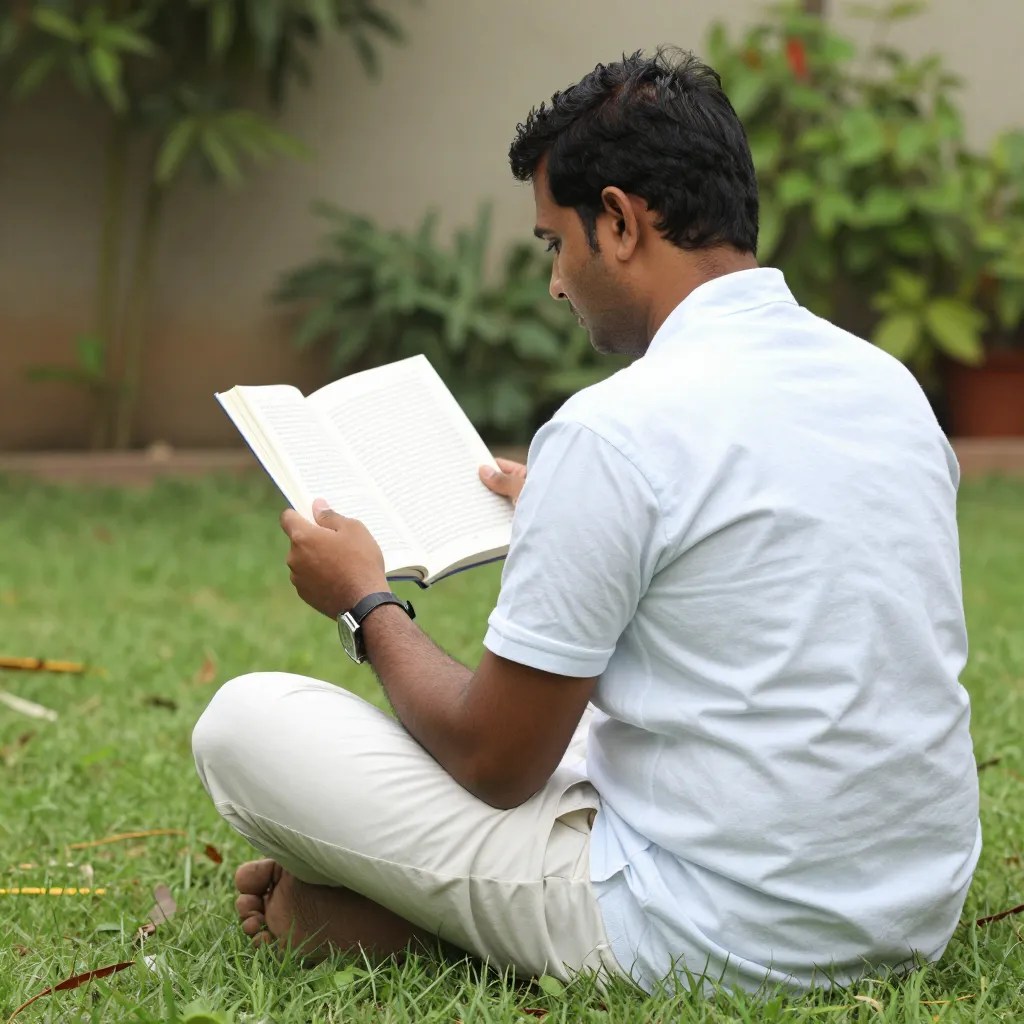
Why is it that one should read? Or for that matter, why should one read anything? For starters, I think basic reading is an operational necessity if one needs to function in this world. However, even that isn’t so easy to come by for many.

The 2024 Annual Status of Education Report (ASER) suggests that almost one-third of Class 8 students in India can’t read at the expected level. I assume, however, that everyone who can read this article – or who will ever read it – has this basic ability to read.

My quest goes further. It is to understand why do we choose to read something that goes beyond our basic day-to-day functioning?

I think I have found my answer.

The reason I read is because I have this innate curiosity to learn about the world as accurately I can and to understand my place in it. I also read to be conscious. As Jeff Hawkins says, “Consciousness is the moment-to-moment memories of our actions and thoughts”. In a way, then, I read to be alive and to incessantly update my understanding of myself and the world.

Where it began for me

Like most things in life, the genesis of anything meaningful (or traumatic) can be traced back to our childhood. When I look back at my own childhood, I feel that I have always had a love for reading, but it was rather undiscovered.

In India, reading is more about the outcome – performing well on a test or getting through a job – instead of a process of enjoyment, discovery, or curiosity.

I first discovered reading as a process that I loved when I read and re-read Julius Caesar by Shakespeare in Grade 9. That was the first real inclination that I loved reading. But there was hardly any way that I could have built on that inclination. Money was short and mobility was limited. All I could read were school textbooks.

That has changed recently. I have been reading more and more courtesy of the ability to not only buy more books but by having spent days and nights developing my reading muscle. And that has really changed who I am. It has changed how I understand the world and my place in it.

How reading changed my perception of the world

Some of my beliefs have fundamentally changed. Here are a few examples –

Earlier belief
(when I would believe what was told to me)
Current Understanding
(based on what I have read)
You are born with talent. It’s in your genes or not. Talent can be developed. Everything and anything can be learned.
We (humans) are created by someone called God out of thin air.Humans are the result of billions of years of evolution and have emerged from a single-celled organism.
My moral choices will decide if I go to hell or heaven. Ex: Attraction towards opposite sex is morally wrong and you should feel ashamed of yourself.There is no hell or heaven. Attraction towards opposite sex is part of who we are as human species. That’s how we propagate our genes.
Money could very well define the true meaning of happiness.Money is important, but only a part of the true meaning of happiness
You always need to listen to your parents/elders because they are always right.Your parents/elders are humans too – and they are wrong many times. You have to learn how to outgrow them.
Your first instinct about something is usually right since it is coming from your gut.Your first instinct is mostly wrong as it depends on your old brain, which is driven by survival.
Eating sugar as much as you can is okay.Eating sugar has many negative consequences and is largely a function of the old brain wanting to gather as many calories as possible

There are many such examples that I can think of. The point is I would never have updated my earlier beliefs had I not read as much as I had over the last few years and applied those learnings in my life.

One may ask what’s the point of all this anyway? My current understanding can still be proven wrong. That’s where what one reads becomes important. My criteria –

  1. I read books that have stood the test of times or what we call are the classics, especially when it comes to topics like philosophy or religion.

  2. I read books written in simple language that explain peer-reviewed scientific concepts. I am not a scientist, so I often seek help – especially from my wife, who is a scientist – to check the understanding I gain from these books.

Reading in 2025

The year 2025 was a decent year for me in terms of what I read and how much I read. I am limiting this article only to full-length books and not including newspapers or online articles.

In total, I read 28 books, which comes out to roughly 2.5 books a month. I would have liked to read more, but this is the best I could do.

THE BOOKS I READ (In order)

  1. Brave New Words, Sal Khan.

  2. The Almanack of Naval Ravikant, Eric Jorgenson.

  3. Sapiens, Yuval Noah Harari.

  4. Lifespan, David Sinclair.

  5. The Disciplined Mind, Howard Gardner.

  6. Changing Minds, Howard Gardner.

  7. How Economics Explain the World, Andrew Leigh.

  8. As Gods Among Men, Guido Alfani.

  9. Mindset, Carol Dweck.

  10. Poor Charlie’s Almanack, Charlie Munger (half)

  11. Origin Story, David Christian (half)

  12. Brave New World, Aldous Huxley.

  13. Kafka on the Shore, Haruki Murakami.

  14. Harry Potter and the Sorcerers’ Stone, J.K. Rowling.

  15. Harry Potter and the Chamber of Secrets, J.K. Rowling.

  16. The Good Life, Marc S. Schulz and Robert J. Waldinger.

  17. Harry Potter and the Prisoner of Azkaban, J.K. Rowling.

  18. The Diary of a Young Girl, Anne Frank.

  19. The Happiness Files, Arthur Brooks.

  20. The Price of Our Values, Augustin Landier and David Thesmar.

  21. Career and Family, Claudia Goldin.

  22. Harry Potter and the Goblet of Fire, J.K. Rowling.

  23. How the World Really Works, Vaclav Smil.

  24. The Coming Wave, Michael Bhaskar and Mustafa Suleyman.

  25. The Journey Home, Radhanath Swami.

  26. Numbers Don’t Lie, Vaclav Smil.

  27. A Thousand Brains Theory, Jeff Hawkins.

  28. Sri Aurobindo and the Mother on Education

Patterns that emerged

Interestingly, as I look back, there emerged a pattern from what I read –

  1. The Future of AI and humans:

    I inherently got curious about AI and where it is going. I started the year with Sal Khan’s ‘Brave New Words’ which talks about how education will evolve with the coming AI revolution and ended up with Mustafa Suleyman’s, ‘The Coming Wave’ and Jeff Hawkins,’ ‘A Thousand Brains Theory’.

    Reading them makes me convinced that AI is NOT becoming more intelligent than humans in totality for many years to come. Yes, it will do some tasks much better than us but becoming better than humans in ALL tasks at once is probably a far-fetched dream.

  2. My childhood Wish List:

    As a young kid, I wanted to read the Harry Potter books but never had the chance. I also tried to read Anne Frank’s diary about her time spent in hiding during the World War 2 (read my post on her book) but found it too difficult to read. This year, I managed to finish four Harry Potter books and the famous diary.

  3. Understanding the World through Economics and Practicality:

    The book that made the greatest influence in this category has to be the one by Claudia Goldin called “Career and Family”. It’s the book that got her the Nobel Prize in Economics. The central idea of the book that in today’s world where women wants both career and family, couple equity matters.

    Another one is “How the World really works” by Vaclav Smil in which he says that despite what anyone says, the world will keep running on fossil fuels for many more years to come. Did you know that almost 83% of all our primary energy needs is still driven by fossil fuels? It was almost similar a couple of decades back too.

  4. Understanding Happiness:

    Since childhood, I always wanted to understand happiness. I have always believed that happiness is not driven by money or accomplishments alone. Rather it is a driven by good relationships.

    This belief was validated by Schulz and Waldinger’s book, ‘The Good Life’, which has to be the best book I read this year since it gives solid evidence by the virtue of being the longest study on happiness spanning more than 85 years.

    Some of what they said was also echoed by Arthur Brooks in his book ‘The Happiness Files’ but if I have to choose one, I will go with The Good Life.

  5. Books on education:

    Being an educationist, this category had to be there. But honestly none of the books I read this year gave me something new.

If I had to recommend my top three books of the year that everyone must read:

  • The Good Life
  • The Diary of a Young Girl
  • How the World Really Works

Add-on: Brave New World (a classic)

I don’t know what the next year will bring when it comes to reading, but I am hopeful that I read more than I did this year – and that I come closer than I am today to better understand this world and myself.

Any recommendations on what should I read in 2026?

REFERENCES

Annual Status of Education Report (ASER) 2024, Pratham Education Foundation
https://www.asercentre.org/aser-2024

Standard
Notes to my child, Philosophy

Why I Chose to Phase Out Social Media From My Life — And How You Can Too

Social media is all around us. And it is making us dumb, dumber, and dumbest. We are spending more time scrolling through our digital profiles than talking to our “actual” family members or “physical” friends. Our relationships have evolved to become more personal with our devices and online connections than with the fellow human beings.

Being born in the 1990s, I do have some semblance of the time when our lives were without mobile phones and social media. Good thing about that time was that me and my physical friends would spend most of our time playing active physical sports instead of being head-down in our phones getting dopamine-laced videos thrown at our faces! Ah, good times!

Recent evidence has supported concerns about early smartphone exposure. A multi-institutional study led by Children’s Hospital of Philadelphia found that children who owned a smartphone by age 12 had significantly higher risks of depression, obesity, and poorer sleep outcomes compared with peers who did not (Nagata et al., 2024).

Additional research links high screen time with reduced sleep quality, shorter sleep duration, and increased risk of anxiety and depression among youth (Saepuloh et al., 2023).

Personally, I have noticed similar effects as an adult. By tracking my sleep with an Apple Watch and observing how refreshed I feel the next morning, I have consistently found that my sleep is of much higher quality when my phone is kept away from my bed rather than within reach.

For years, I have been an avid user of social media. I remember using Orkut, one of the earliest social-networking platforms, and later moving to Facebook when it launched in the early 2010s. At that time, it genuinely felt like these platforms could help me reconnect with old friends, express my voice, and access the larger “know-hows” of the world. And, in many ways, I was right. For example, I used social media to raise ₹2,50,000 for a charitable cause a decade ago.

But today, the benefits feel overshadowed by the negative repercussions. My top five concerns include:

  1. Invasion of privacy and associated risks
    Anyone can know who you are, what you do, if you keep posting about who you are, and what you do! It gives negative actors incentives to harm you and your loved ones by picking your habits etc. Research shows that seemingly harmless social-media activity can reveal personal routines, social networks, home locations, travel schedules, and even personality traits (Kosinski et al., 2013).

  2. Weaponization of social media profiles by governments
    Governments, especially those interested in surveillance, can use metadata from social media (who you know, what you post, where you are) to track citizens. Globally, there has been growing concern over how social media data can be used for surveillance, behavioral profiling, and influencing public opinion. As more people share personal data online, governments gain more tools to monitor, manipulate or control.

    I predict such weaponization is going to only increase exponentially and it’s a good time to stop sharing your personal data for future manipulation and misuse. Good books to read how such a scenario may look like are the classics: 1984 by George Orwell and Brave New Words by Aldous Huxley.

  3. Manipulation of your thoughts and actions by current and future technology
    Social-media platforms already use algorithms to shape what you see: what content appears in your feed, what ads you receive, what friends or pages are suggested. These algorithms optimize for engagement — often by exploiting your psychological vulnerabilities.

    As AI gets more advanced, this manipulation may become more subtle, pervasive, and personalized. The more these systems know about you, the more effectively they can influence your beliefs, moods, decisions — potentially overriding your true self. I mean, why deliberately tell machines who you actually are?

  4. Misinformation-
    We all know what it is and how easily it spreads.

  5. Depression, anxiety, and the constant need to compare yourself with others
    Multiple studies link heavy social-media use to depression, anxiety, poor self-esteem, and negative social comparison particularly among adolescents and young adults (Shensa et al., 2018; Saepuloh et al., 2023). The design of these platforms encourages constant comparison, envy, and the fear of missing out, driving cycles of emotional distress.

It is for these reasons – or for the harmful effects of this addiction – that for the last one-and-half years, I have systematically reduced my social media usage. And mind you, doing so has been really hard work and I am not completely out of bounds!

If we take alcohol addiction, we all agree that it is bad for our health and there are both government and non-government support mechanisms to help you get over the addiction. However, despite clear indications that excessive social media usage is harmful for you, there are no widespread support mechanisms in place yet.

So here is a strategy that worked for me:

  1. Track and observe your usage
    My professor at Harvard Business School used to say that “you can only manage what you can measure and you can measure everything”. Hence, the first step is to measure your social media usage across all the social media platforms (and yes, that includes Whatsapp). Do it for at least a week or ten days and see what’s your average. If it is more than four hours, you probably have an addiction problem.

  2. Deactivate (not delete) your social media profile(s) in a phased manner
    Don’t believe that you can get over your social media addiction in one go. I have seen many people deactivating ALL their social media accounts in one go (mostly when they have a fight with their partners) only to reactivate them the next morning. And let’s be realistic – you are not going to “delete” your accounts so lets not go there.

    Hence, a better strategy would be to start with the account you are spending the least time on. In my case, I started first with Facebook > Instagram > LinkedIn > Twitter. I am still left with YouTube and WhatsApp – they are being the most difficult to let go.

  3. Temporarily reactive and observe your emotions
    Reactivate your deactivated account(s) and observe all the immediately occurring emotions and feelings. In my case, whenever I’d do so, I used to get the feeling of unnecessary comparison, anxiety, and FOMO.

    Interestingly, I’d never felt any of these emotions when the account(s) was deactivated. After doing this at least three or four times, I could clearly see that these negative feelings were stemming from the design of these platforms and not inherently from who I am.

  4. Fill the newfound time with meaningful activities or hobbies
    One of the side effects of phasing out your social media is that you will find that suddenly you have a lot of time. You will realize that you are finally bored! And that’s a good thing.

    Psychological research shows that boredom can enhance creativity, reflection, and intrinsic motivation (Westgate & Wilson, 2018). When you feel bored, it is time to do things you actually enjoy doing.

    For me, it was reading books (I have read 24 books so far in 2025), playing Tennis and being obsessed with my health markers (my VO2max has increased from 26 last year to 43; I can now run a 5k nonstop – last year I couldn’t even run 500m without catching my breath). Each person can find their own meaningful replacement: writing, gardening, dancing, learning a language — anything that genuinely nurtures you.

  5. Keep phasing out and stand your ground
    Peer pressure is real: people expect you to be “on” all the time- reachable on WhatsApp, posting on Instagram, liking photos, replying to memes. But you don’t have to. Be honest with yourself about what matters. Stand firm. You owe it to your mental health and sense of self.

Imagine a few hundred years ago a person was kidnapped from Africa and transported in a dark, dingy ship compartment to work in forced labor in the fields of England or America. That person had no choice. Slavery was an accepted practice in many parts of the world and was not considered morally or legally wrong the way it is today. It took years- and a great war- for the society to recognize it as a crime and abolish it.

In a similar way, today – though far less visibly cruel – many of us are enslaved to our mobile phones, to social media, and are moving towards a scenario where we will be enslaved by newer technologies and machines that we will create ourselves.

But, unlike those who were enslaved hundreds of years ago we still retain a power they didn’t: the power to say NO.

And NO! we must say. Let us not glorify our own bondage. Let us not be slaves.

REFERENCES

Nagata, J. M., Rahman, F., Fiore, K., Bissonette, A.,-Peterson, K. E., & Cunningham, S. (2024). Smartphone ownership in childhood and associations with depression, obesity, and sleep. Children’s Hospital of Philadelphia.

Saepuloh, A., Santoso, M. B., & Hasanah, U. (2023). The correlation between smartphone screen time and sleep quality in adolescents: A systematic review. Medical Sciences, 13(6), 475.

Kosinski, M., Stillwell, D., & Graepel, T. (2013). Private traits and attributes are predictable from digital records of human behavior. Proceedings of the National Academy of Sciences, 110(15), 5802–5805.

Shensa, A., Sidani, J. E., Dew, M. A., Escobar-Viera, C. G., & Primack, B. A. (2018). Social media use and depression and anxiety symptoms: A cluster analysis. American Journal of Health Behavior, 42(2), 116–128.

Westgate, E. C., & Wilson, T. D. (2018). Boring thoughts and bored minds: The MAC model of boredom and cognitive engagement. Behavioral Sciences, 8(6), 54.

Standard
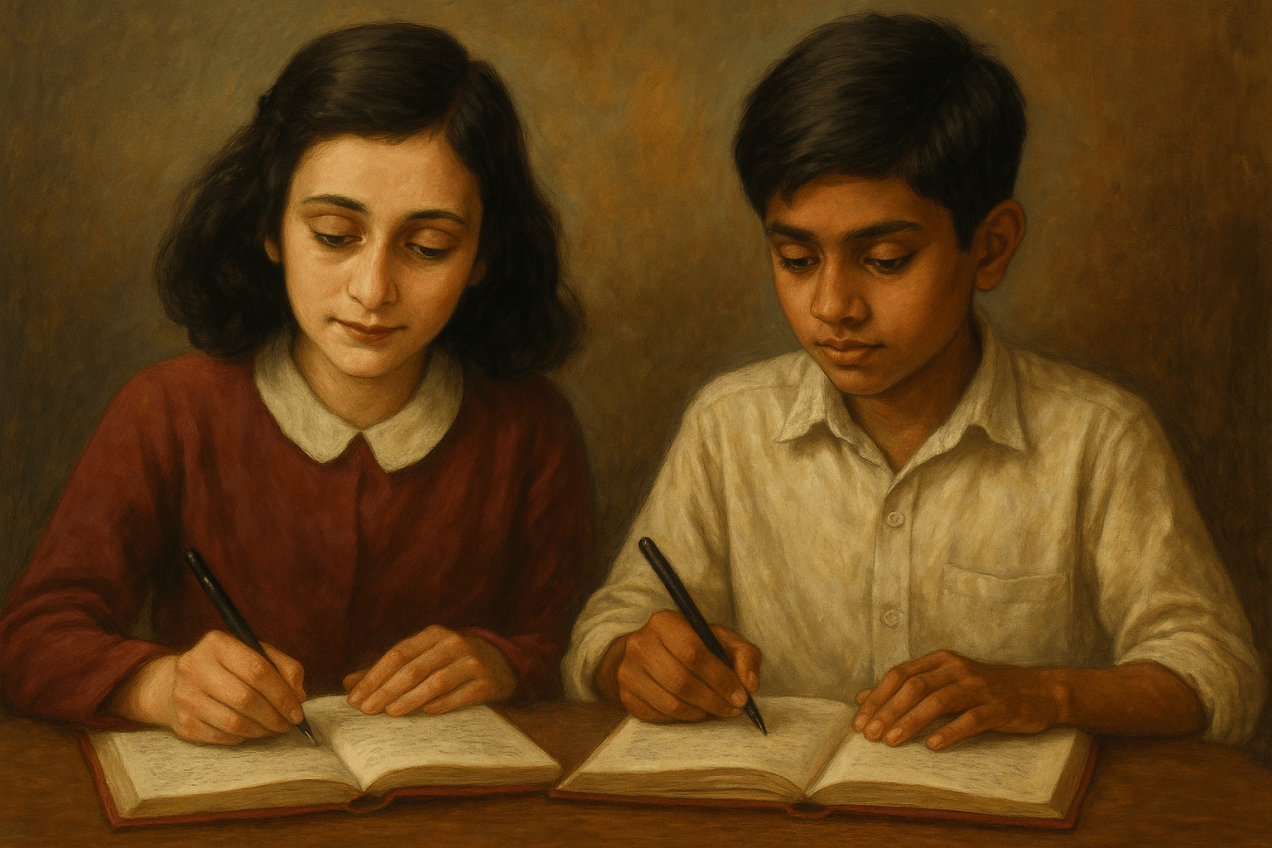
Anne and a boy writing in their diaries together
Notes to my child, Philosophy

To Live and Die Is to Express – Lessons from a Diary

The Question of Purpose

Purpose is such an intriguing word. Why do we choose to do the things we do in life? My dearest friend who dreams of becoming a filmmaker recently asked why he should bother pursuing anything worthwhile—or even something he loves—when, in the end, we all have to die?

It’s a profound question, one without a single, simple answer. Yet, few stories and moments often help us glimpse possible responses. For me, one such answer revealed itself in the pages of Anne Frank’s diary, written by a young Jewish girl who perished in the Holocaust during World War II.

Meeting Anne for the First Time

Called The Diary of a Young Girl, I first came across this book when I was just starting to explore the world of reading as a young eighteen-year-old. I remember trying to read it then, but as the saying goes, “you don’t choose your books; they choose you”— and in that moment, the book had decided to reject me.

I don’t know why I felt compelled to return to this book at this moment in my life. The thought about my life’s purpose shouldn’t be the cause because I do feel certain of it—to improve the lives of millions of underprivileged children in India—and yet, I still found myself drawn back to these pages.

Maybe it was a quiet intuition, or perhaps a kind of divine signal, that led me to it. I simply felt drawn to discover what this young girl of thirteen had written in those 330-odd pages before she and her family were taken from their hidden refuge and sent to the concentration camps. This time, the book let me in. And it has already changed my life.

Finding Myself in Anne’s Writings

Reading Anne’s diary made me think back about the time I had started to write my own diary (later discontinued) when I was in Grade 7 or 8—around the same age as Anne. Of course, in hindsight, what I was going through as a twelve-year-old was in no way close to what Anne endured. She was hiding from the Nazis inside a secret annexe in the middle of a war, unable to step outside, while I was simply navigating the small-er dramas of adolescence. But as a teenager, “your” challenges feel most important to you.

Perspective-taking and empathy takes time. Evidence from child psychology hints that empathy and perspective-taking continue to develop into the teenage years, with notable patterns emerging especially during the late adolescent period.

A six-year longitudinal study following adolescents from ages 13 to 18 found that perspective-taking increased consistently across adolescence, indicating that the ability to adopt others’ viewpoints develops substantially during the teenage years and continues to strengthen into late adolescence (Van der Graaff et al., 2013).

While perspective-taking shows steady growth, empathy itself follows a more complex developmental path.

A study summarized by Melbourne Child Psychology reported that cognitive empathy—the capacity to understand another’s perspective—emerges earlier for girls, beginning around age 13, while boys typically do not show similar growth until about age 15. By contrast, affective empathy, which reflects the emotional responsiveness to others, tends to dip in boys between ages 13 and 16 before rebounding later in adolescence, suggesting a temporary decline followed by recovery in emotional empathy during the teenage years (Melbourne Child Psychology, n.d.).

The beauty of Anne’s diary is that you can actually witness this growth many years before this research was contemporary. Between the ages of thirteen and fifteen, her writing reflects a deepening perspective and a widening empathy—especially in the way her relationship with her mother evolves. She begins with sharp criticism, often feeling misunderstood, but over time her words soften, carrying traces of compassion and self-awareness.

Shared Struggles of Adolescence

In Anne’s struggles, and growth, I found echoes of my own teenage self. Like Anne, I too wrestled with the urge to be independent—“please let me be… leave me alone!” I felt the need to push away adults—“I am my own person… don’t tell me what to do!” I carried confusing feelings about the opposite gender—“What is this feeling… am I in love?” And I wanted nothing more than to be seen as honest—“Don’t ever tell me that I lie…”

There were other areas of resonance too: Anne didn’t like Algebra, neither did I. Anne loved reading and thinking deeply about human emotions—so did I. Anne wanted to become a writer or a journalist—so did I. And despite the Nazis’ annihilation of the Jews, Anne believed in the good in people. So did I.

The Power of Expression

But there was more than resonance that made Anne’s life special and why she was different than everyone her age (and beyond) those days and today. She was special because she chose to give value to how she was feeling—and to express it with what she had in that moment. For her, that meant words. Unknowingly, she had found a purpose. And that made her immortal.

The most wonderful thing about reading her diary is that you don’t feel that she was writing for the world. Living a double life —on one side she could be caught at any moment, and on the other she might survive the war—she still kept on writing for herself. She wrote to understand herself, to become better.

And that’s what makes her lesson so powerful. As individuals, what we go through every day often seems too ordinary. It doesn’t feel important. We convince ourselves that in the noise of the world, our feelings and stories don’t matter. For the longest time—maybe even for our entire lives—we ask: who will hear what we have to say?

The fact that Anne must have felt this too, but still chose to express, is what makes her life and her story so extraordinary.

Time: Endless and Fleeting

There isn’t much time left. There is a lot of time left. Which statement do you think is true? Believing that we may die in the next moment—courtesy of life’s unpredictability—the first feels true. Believing that we have years ahead, the second feels true as well. The fact is that both statements are true at the same time.

The double-truths resemble Schrödinger’s cat—the famous thought experiment where a cat could be considered both alive and dead at the same time

As humans, we know deep down that our lives are totally unpredictable. We can go poof anytime. Still, we go on thinking that we have an “entire” life in front of us—until it is not. And when we believe our lives to be eternal, we postpone expressing our deepest feelings. We forget to tell others—and, most importantly, ourselves—what we truly think.

The Choice to Express

And yet, Anne did not forget or postpone. She wrote. She expressed. Even in the confines of an attic, even in the face of constant fear, she chose to give her feelings a voice. And through that simple, honest act, she continues to live.

That, to me, is Anne’s greatest gift: a reminder that expression itself can be purpose. It doesn’t have to be grand, it doesn’t have to be meant for the world—it just has to be true.

So, just like Anne, we too must continue to express, in whatever way we can. For some, that might mean writing; for others, it could be painting, singing, filming (my friend), teaching, or even simply speaking honestly to a friend. Expression doesn’t have to be grand—it just has to be true.

For me, that means writing more, and making space for my thoughts to breathe on paper (and online). It has now become not just an act, but an added purpose of my life. And perhaps, in doing so, I will leave behind a small echo—one that says: I too lived, I too expressed.

So let me ask you—when your time comes, will the world know that you lived, because you expressed?

REFERENCES

  • Van der Graaff, J., Branje, S., De Wied, M., Hawk, S., Van Lier, P., & Meeus, W. (2013). Perspective taking and empathic concern in adolescence: Gender differences in developmental changes. Developmental Psychology. Link

  • Melbourne Child Psychology. (n.d.). Helping Teenagers Develop Empathy. Link
Standard
Notes to my child

Why I may never send my kids to school

Three seismic forces are reshaping the modern world, altering not only our societies but also the futures of our children. These shifts—political, technological, and emotional—demand that we rethink how we live, work, and raise the next generation.

1. The Age of Certain Uncertainty

The world is becoming increasingly unpredictable and protectionist. Much of this shift stems from the rise of leaders who govern through personal vendettas and act on conspiracy theories driven by the “viral” culture on social media. The lines between truth and falsehood are increasingly blurred. In the new world, where any action can be deemed harmful depending on who wields power, becoming positively invisible is a kind of a superpower.

Deep thinking itself is becoming rare. Science has been pushed to the margins, replaced by spectacle and noise. Reading—once the quiet foundation of informed societies—is also in decline. As data journalist David Montgomery notes in his analysis, “just over half of all Americans said they read at least one book in 2023,” and of those, an overwhelming 82% read ten or fewer. These are shocking numbers that show deep, sustained engagement with ideas is rapidly disappearing. Similar trends can be observed in other parts of the world.

My point is, that as humans, we are prioritizing surface level understanding driven by byte-sized dopamine-laced information over in-depth understanding.

2. The AI Moment

Artificial intelligence (AI) is transforming the very way we think about our education and work. As our capacity for deep engagement diminishes, the rise of AI adds another layer of disruption—challenging not just what we learn, but how we learn. For example: with AI’s advent, no longer do we need to polish our handwriting skills (remember the handwriting competitions that used to happen in schools?) or our typing skills (the typing speed tests?) on a computer.

The challenge is no longer about rote skills but about asking the right questions, synthesizing knowledge, and shaping work that feels meaningful to each individual. All of this requires critical thinking about who we are, what we want in life, and what makes our lives meaningful.

Crucially, education and work are no longer bound to a single location; they can flow from anywhere, as long as we bring creativity and purpose to it.

3. A Pandemic of Loneliness

Despite unprecedented global connectivity, people are lonelier than ever. In their groundbreaking book “The Good Life: Lessons from the World’s Longest Scientific Study of Happiness”, researchers from Harvard’s Study of Adult Development report that about one in four Americans—over sixty million people—say they feel lonely. According to the book, the problem is not confined to the United States. In China, loneliness among older adults has surged in recent years, while in Great Britain the crisis has grown so acute that the government has appointed a “minister of loneliness.” The Longitudinal Ageing Study in India (LASI)—surveying nearly 72,000 adults aged 45 and older—found that 20.5% reported feeling moderate loneliness, while 13.3% experienced severe loneliness.

The new paradox of our age is that while technology promises us to connect with people and make our lives easy, we are feeling more isolated within ourselves. Loneliness, left unaddressed, drains life of its meaning. The recent experience of Covid has also made individuals wonder about their priorities in life with more people wanting to spend time with their loved ones.

Schools in the Shadow of These Shifts

Under the umbrella of these sweeping changes, I wonder how do we raise our children to become thoughtful, kind, resilient and happy individuals capable of leading good and meaningful lives? Increasingly, I wonder if sending them to schools—at least as they currently exist—is the right choice.

Most of us know that the modern school system is, in many ways, a relic of the British-led Industrial Revolution. Its structure— rows of desks, bells that mimic factory whistles, standardized curricula, over-emphasis on English language—was designed to produce compliant thinking in students. But the world of tomorrow does not need compliant workers; it needs independent thinkers, creative builders, and empathetic humans.

Encouragingly, some countries are beginning to recognize this. India’s National Education Policy 2020, for instance, calls for a shift away from rote memorization toward play-based learning, conceptual understanding, and exposure to diverse languages and experiences. It’s a step toward reimagining schools as places that nurture curiosity and creativity rather than conformity—though the gap between policy and practice remains.

Schools today are also starting to overindulge in digital tools without teaching children how to counter their ill-effects. Instead of protecting kids from distraction, they amplify it. Teachers distracted by phones, lessons funneled through screens, and students scrolling endlessly erode the very capacities our children need most: concentration, patience, and long-form reasoning.

As one recent New York Times essay put it, the smartphone has become a direct assault on literacy, democracy, and our ability to think clearly. Documentaries like Adolescence on Netflix highlight just how devastating digital overexposure can be while schools remain ill-equipped to shield them.

Defining a Good Life

Every time I reflect on these issues (mostly with my wife), we arrive at an unsettling conclusion: perhaps sending our future children to schools, as they currently exist, may not be the best choice.

At the heart of this reflection, pressed against the changes in the current world, is our own definition of a good life—one we wish to pass on to our children. For me, it has three components.

First, relationships. Decades of research confirm that good relationships—with family, friends, spouses, and even colleagues—are the single strongest predictor of happiness and well-being (for more, read The Good Life). While schools predominately focus on reading, writing, and giving subject-matter knowledge, they rarely teach the art of building and sustaining relationships.

In fact, I wonder: since educated parents already take responsibility for giving their children the knowledge and skills they need, and now have tools like AI to help, why should kids still have to sit in rigid classrooms away from their parents, siblings or grandparents? Parents who are busy or less educated may still need schools to teach their kids, but today there’s little reason for educated parents to do the same if they have the time and resources – both human and monetary.

Also, if Covid taught us anything, it is that time with our loved ones is finite and precious. I want our children to grow up experiencing family not as something squeezed into evenings and weekends, but as a central pillar of their lives.

One can argue that schools are where children socialize and make friends for lifetime. There is merit in this argument. However, in today’s world, children can still make friends outside traditional schools—through smaller, interest-driven communities that foster deeper bonds. They can participate in smaller group activities aligned with their deep interests at time and place of their choosing.

Imagine a child beginning the day in meditation with peers, playing football or tennis in the afternoon, and ending with a book discussion with another set of friends. Now imagine the next day where the child decides to spend the entire day with their grandparents reading books. Such interest-driven communities and choices build agency, decision-making, and collaboration—qualities schools often replace with competition and comparison.

Second, if relationships anchor happiness, meaningful work anchors purpose. With AI and robotics taking over much of the routine labor, what remains for humans is the pursuit of purpose. Our children will need to do the work they love—work that not only sustains them but also contributes something positive to the world.

Schools, however, are still preparing students for industries of the past, where conformity and compliance mattered more than creativity and passion. To identify and do meaningful work, what is needed is self-reflection and self-understanding of the highest order. As kids remain outside the ambit of the traditional schools, they have a better chance of developing these higher order tools.

Third, the power of digital invisibility. A recent estimate shows that people worldwide are spending more than six hours every day on screens. And that spending time online makes us feel more anxious, fearful and lonely. Factor in eight hours of required sleep and another eight of obligatory work or schooling, and what remains is a mere two hours a day—just one-twelfth of our lives—for reflection, relationships, and meaning – things that make a good life.

To spend nearly 90% of our waking life in distraction and compliance is to squander life itself.

Personally, I do not want my children to spend six hours a day exposed to digital devices that make them anxiously visible to the world and vulnerable for manipulation. And unless today’s schools truly change and realign towards helping children lead a good life, I do not want our children to spend another eight hours of their youth training to be compliant workers.

Instead, I want them to spend those fourteen hours with family, with friends, with books, and with themselves. I want them to become invisible to the noise of the world so that they may be visible in the lives of those who truly love them.

I would rather raise children who are fully alive than children who are merely schooled. And that is why I may never send mine to a school.

Standard
Notes to my child

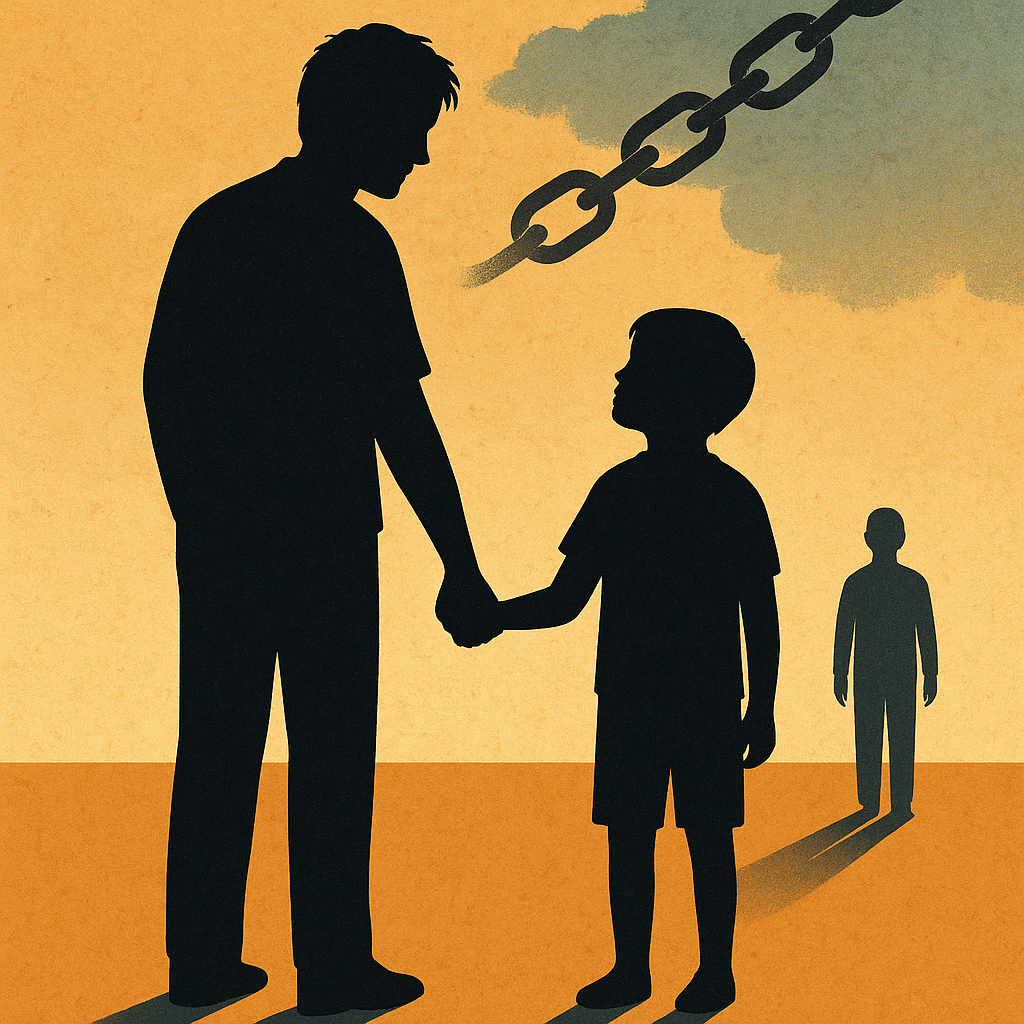
Fear Is Learned — And We Can Choose Not to Pass it on

One sunny afternoon, as my wife was working on one of her academic papers, she told me she had been feeling fearful — of the writing process, and of the feedback she might receive from her guide and the scientific community. When I asked why she felt this way despite being well prepared, she admitted that, even now, she sometimes experiences the same fears she had as a child. It wasn’t failure she was afraid of, but the possibility of not producing a paper that was perfect.

Many of the fears we carry into adulthood are not entirely our own. They are echoes — internalized through childhood experiences, social environments, and often, the unspoken anxieties of those who raised us. Psychological research shows that fear responses are not purely innate; they are also socially learned and transmitted across generations (Gerull & Rapee, 2002).

Her story reflects this truth: fears from childhood often remain embedded in adulthood and if not acted upon can be traversed to our next generation i.e. our kids.

These fears can emerge from multiple sources –

  1. Direct and deep personal experiences (e.g., repeated punishment, ridicule) as a child;

  2. Socio-economic circumstances (e.g., scarcity, instability);

  3. Educational environment (e.g., high-stakes grading, unsupportive teachers);

One of the most common ways children internalize fears is through parental modeling — observing and adopting their parents’ anxieties. I will focus primarily on this aspect in this piece.

This is part of a writing series I am calling “Notes to my child” where I am trying to document my thoughts and strategies of raising my future kids and sharing these with my co-travelers.

Positive vs Negative Fear

Let me also clarify that no parents actively try to make their children fearful or pick up their anxieties. In fact, it’s the exact opposite. Both as current or future parents, it’s important that we raise our children without unnecessary fear. This is harder to do than it sounds.

Positive fear is necessary. It helps a child survive in this world. It ensures that they don’t poke their fingers inside the electric switch board or stand, smiling, in front of a pouncing lion.

While positive fear can be considered as a built-in alarm system”, the negative fear is a built-out, overactive alarm system”. It goes off even when there’s no real danger.

A Thought Experiment: Three Parenting Advice

How does this negative fear get transferred from parents to children then?
Let’s try to understand this with the help of a thought experiment:

Imagine a ten-year old child who has been asked to speak in a school assembly on the topic of “cleanliness”. The child comes home and tell this to his parents. The parents help prepare him a paragraph on the topic and asks him to practice.

Imagine this child being raised by three different set of parents: Parents 1, 2, and 3. Each set of parent gives different set of instructions and/or set different expectations for their child.

Parent 1:You have to make sure that you remember everything by heart and don’t forget anything while you speak. It has to be perfect and according to what we taught you. Remember practice makes a man perfect! The way you perform in pressure situations will indicate how well you will do later in similar situations in life.”

Parent 2: It’s good that you remember everything and we hope that you will be able to speak what you have prepared. It might happen that you forget a few things while on stage but you should remember the overall message on cleanliness that you want to convey! Good luck!

Parent 3: We don’t think that you need to prepare anything for such a simple topic or that you need any help from us. Just go and speak what you think comes to your mind. Just remember to not say anything stupid. Anyway, we don’t have much time to give.

Now, the next day, the child performance, on a parameter of 100% perfection was, lets say, 80%. He forgets something during their speech but manage to put up with the task. How do you imagine Parent 1, 2 and 3 to react? I believe it will be something like this –

Parent 1: “You forgot the last line we practiced! We told you exactly how to say it. You need to prepare more seriously next time — mistakes like this can be avoided.”

I will call this type of response as a “Perfection-Driven Response. Research says that, for example, “fathers of high socially anxious children exhibited more controlling behaviors. (Flett et al., 2002).”

Parent 2:
“You spoke well! You missed a few points, but you got the message across — that’s what matters. Next time, you can add those points too.”

I will call this type of response as a “Encouragement-Centered Response.” Research says that Growth-oriented feedback fosters resilience and intrinsic motivation. Carol Dweck’s work in this regard is path-breaking where she speaks on growth vs fixed mindset.

Parent 3:
“At least you didn’t embarrass yourself. See? It wasn’t that big a deal.”

I will call this type of response as a “Hands-Off Response.” Research says that emotional neglect or low parental engagement can reduce self-efficacy and ambition.

What do you think were the child’s takeaways from each parent’s responses and how these takeaways would echo in children’s adult life?

Here’s my take –

Breaking the Cycle

Objectively speaking, each child received same results. But it received different reactions by parents resulting into starkly different takeaways by the child. These takeaways, and many such similar experiences through parental interactions, starts to define a child’s personality including their anxieties and fears.

Breaking this cycle of inherited fear requires conscious, consistent effort as an adult. This becomes even more critical if as parents we want our children to lead lives without any kind of negative fears.

Some strategies include (but not limited to):

  1. Self-Awareness First – As adults, we should start by identifying our own learned fears before addressing them with children. Activities such as reflective journaling, therapy, and mindfulness can help uncover inherited anxiety patterns.

  2. Modeling Self-Compassion – Most of the time, adults are too hard on themselves and they forget to treat themselves with self-compassion. It’s important that adults treat both their and children’s errors as learning opportunities rather than proof of inadequacy. Modeling self-compassion in front of children reduces their fear of failure.

  3. Encourage Process Over Perfection – Praise effort, strategies, and persistence instead of flawless outcomes.

  4. Provide Emotional Safety – Create environments where children feel safe to try, fail, and try again without ridicule or disproportionate punishment.

  5. Educate on Fear Itself – Teach children the biological purpose of fear and how to distinguish between positive fear (real danger) and negative fear (false alarms).

We can’t shield children from all fear — nor should we. But we can prevent unnecessary fears from taking root. That means being mindful of the lessons we give, both in words and in the silences between them. By practicing these habits, we reduce the risk of passing on our own fears and anxieties — giving children the space to develop confidence, adaptability, and a healthy relationship with imperfection.

Whenever my wife finally submits her paper, I hope that she smiles and says, ‘It’s not perfect — but it’s done.’ The courage she will learn is the courage that I’d want our children to inherit.

References

Gerull, F. C., & Rapee, R. M. (2002). Mother knows best: Effects of maternal modeling on the acquisition of fear and avoidance behaviour in toddlers. Behaviour Research and Therapy. https://doi.org/10.1016/S0005-7967(01)00013-4

Flett, G. L., Hewitt, P. L., Oliver, J. M., & Macdonald, S. (2002). Perfectionism in children and their parents: Associations with depression, anxiety, and everyday distress. Journal of Psychopathology and Behavioral Assessment.
https://doi.org/10.1023/A:1020779000183

Dweck, C. S. (2006). Mindset: The new psychology of success. New York, NY: Random House.

Standard