
Social media is all around us. And it is making us dumb, dumber, and dumbest. We are spending more time scrolling through our digital profiles than talking to our “actual” family members or “physical” friends. Our relationships have evolved to become more personal with our devices and online connections than with the fellow human beings.
Being born in the 1990s, I do have some semblance of the time when our lives were without mobile phones and social media. Good thing about that time was that me and my physical friends would spend most of our time playing active physical sports instead of being head-down in our phones getting dopamine-laced videos thrown at our faces! Ah, good times!
Recent evidence has supported concerns about early smartphone exposure. A multi-institutional study led by Children’s Hospital of Philadelphia found that children who owned a smartphone by age 12 had significantly higher risks of depression, obesity, and poorer sleep outcomes compared with peers who did not (Nagata et al., 2024).
Additional research links high screen time with reduced sleep quality, shorter sleep duration, and increased risk of anxiety and depression among youth (Saepuloh et al., 2023).
Personally, I have noticed similar effects as an adult. By tracking my sleep with an Apple Watch and observing how refreshed I feel the next morning, I have consistently found that my sleep is of much higher quality when my phone is kept away from my bed rather than within reach.
For years, I have been an avid user of social media. I remember using Orkut, one of the earliest social-networking platforms, and later moving to Facebook when it launched in the early 2010s. At that time, it genuinely felt like these platforms could help me reconnect with old friends, express my voice, and access the larger “know-hows” of the world. And, in many ways, I was right. For example, I used social media to raise ₹2,50,000 for a charitable cause a decade ago.
But today, the benefits feel overshadowed by the negative repercussions. My top five concerns include:
- Invasion of privacy and associated risks –
Anyone can know who you are, what you do, if you keep posting about who you are, and what you do! It gives negative actors incentives to harm you and your loved ones by picking your habits etc. Research shows that seemingly harmless social-media activity can reveal personal routines, social networks, home locations, travel schedules, and even personality traits (Kosinski et al., 2013). - Weaponization of social media profiles by governments–
Governments, especially those interested in surveillance, can use metadata from social media (who you know, what you post, where you are) to track citizens. Globally, there has been growing concern over how social media data can be used for surveillance, behavioral profiling, and influencing public opinion. As more people share personal data online, governments gain more tools to monitor, manipulate or control.
I predict such weaponization is going to only increase exponentially and it’s a good time to stop sharing your personal data for future manipulation and misuse. Good books to read how such a scenario may look like are the classics: 1984 by George Orwell and Brave New Words by Aldous Huxley. - Manipulation of your thoughts and actions by current and future technology–
Social-media platforms already use algorithms to shape what you see: what content appears in your feed, what ads you receive, what friends or pages are suggested. These algorithms optimize for engagement — often by exploiting your psychological vulnerabilities.
As AI gets more advanced, this manipulation may become more subtle, pervasive, and personalized. The more these systems know about you, the more effectively they can influence your beliefs, moods, decisions — potentially overriding your true self. I mean, why deliberately tell machines who you actually are? - Misinformation-
We all know what it is and how easily it spreads. - Depression, anxiety, and the constant need to compare yourself with others–
Multiple studies link heavy social-media use to depression, anxiety, poor self-esteem, and negative social comparison particularly among adolescents and young adults (Shensa et al., 2018; Saepuloh et al., 2023). The design of these platforms encourages constant comparison, envy, and the fear of missing out, driving cycles of emotional distress.
It is for these reasons – or for the harmful effects of this addiction – that for the last one-and-half years, I have systematically reduced my social media usage. And mind you, doing so has been really hard work and I am not completely out of bounds!
If we take alcohol addiction, we all agree that it is bad for our health and there are both government and non-government support mechanisms to help you get over the addiction. However, despite clear indications that excessive social media usage is harmful for you, there are no widespread support mechanisms in place yet.
So here is a strategy that worked for me:
- Track and observe your usage –
My professor at Harvard Business School used to say that “you can only manage what you can measure and you can measure everything”. Hence, the first step is to measure your social media usage across all the social media platforms (and yes, that includes Whatsapp). Do it for at least a week or ten days and see what’s your average. If it is more than four hours, you probably have an addiction problem. - Deactivate (not delete) your social media profile(s) in a phased manner–
Don’t believe that you can get over your social media addiction in one go. I have seen many people deactivating ALL their social media accounts in one go (mostly when they have a fight with their partners) only to reactivate them the next morning. And let’s be realistic – you are not going to “delete” your accounts so lets not go there.
Hence, a better strategy would be to start with the account you are spending the least time on. In my case, I started first with Facebook > Instagram > LinkedIn > Twitter. I am still left with YouTube and WhatsApp – they are being the most difficult to let go. - Temporarily reactive and observe your emotions –
Reactivate your deactivated account(s) and observe all the immediately occurring emotions and feelings. In my case, whenever I’d do so, I used to get the feeling of unnecessary comparison, anxiety, and FOMO.
Interestingly, I’d never felt any of these emotions when the account(s) was deactivated. After doing this at least three or four times, I could clearly see that these negative feelings were stemming from the design of these platforms and not inherently from who I am. - Fill the newfound time with meaningful activities or hobbies –
One of the side effects of phasing out your social media is that you will find that suddenly you have a lot of time. You will realize that you are finally bored! And that’s a good thing.
Psychological research shows that boredom can enhance creativity, reflection, and intrinsic motivation (Westgate & Wilson, 2018). When you feel bored, it is time to do things you actually enjoy doing.
For me, it was reading books (I have read 24 books so far in 2025), playing Tennis and being obsessed with my health markers (my VO2max has increased from 26 last year to 43; I can now run a 5k nonstop – last year I couldn’t even run 500m without catching my breath). Each person can find their own meaningful replacement: writing, gardening, dancing, learning a language — anything that genuinely nurtures you. - Keep phasing out and stand your ground–
Peer pressure is real: people expect you to be “on” all the time- reachable on WhatsApp, posting on Instagram, liking photos, replying to memes. But you don’t have to. Be honest with yourself about what matters. Stand firm. You owe it to your mental health and sense of self.
Imagine a few hundred years ago a person was kidnapped from Africa and transported in a dark, dingy ship compartment to work in forced labor in the fields of England or America. That person had no choice. Slavery was an accepted practice in many parts of the world and was not considered morally or legally wrong the way it is today. It took years- and a great war- for the society to recognize it as a crime and abolish it.
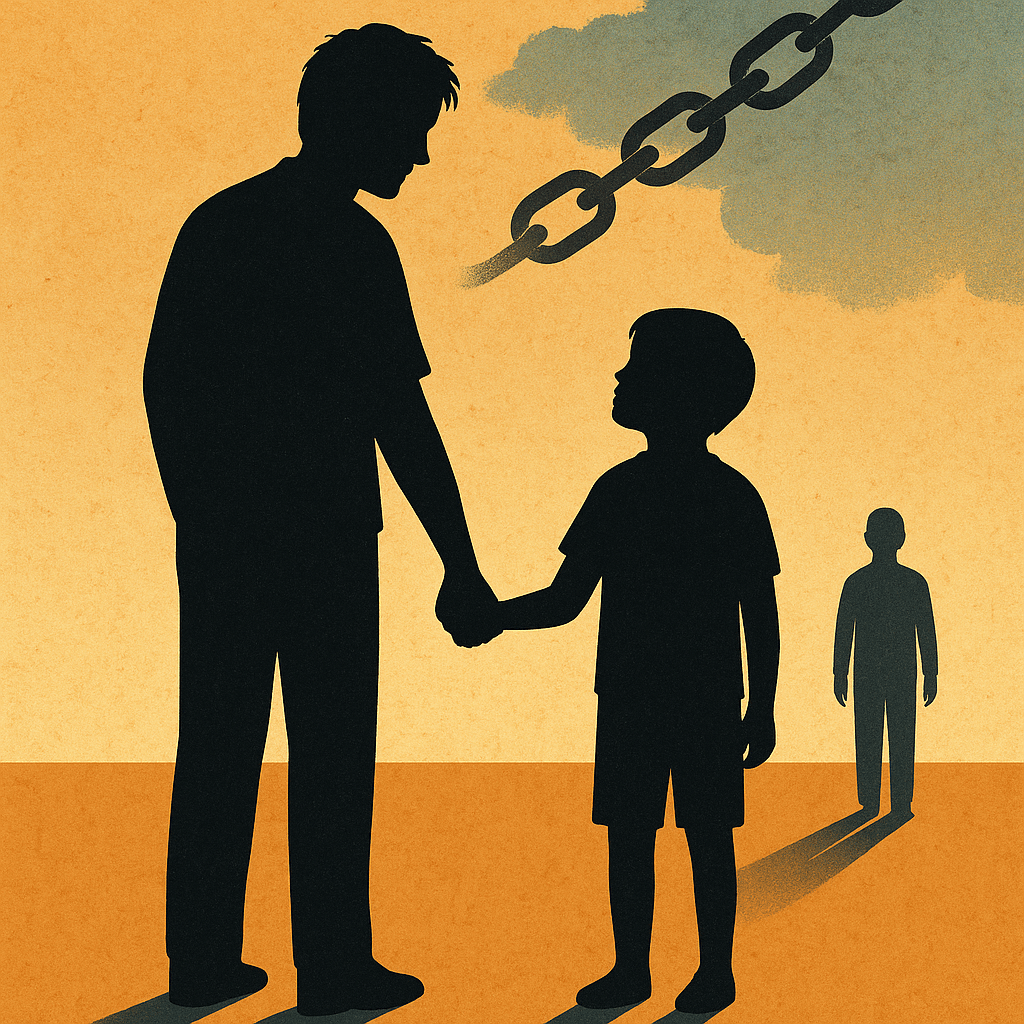
In a similar way, today – though far less visibly cruel – many of us are enslaved to our mobile phones, to social media, and are moving towards a scenario where we will be enslaved by newer technologies and machines that we will create ourselves.
But, unlike those who were enslaved hundreds of years ago we still retain a power they didn’t: the power to say NO.
And NO! we must say. Let us not glorify our own bondage. Let us not be slaves.
REFERENCES
Nagata, J. M., Rahman, F., Fiore, K., Bissonette, A.,-Peterson, K. E., & Cunningham, S. (2024). Smartphone ownership in childhood and associations with depression, obesity, and sleep. Children’s Hospital of Philadelphia.
Saepuloh, A., Santoso, M. B., & Hasanah, U. (2023). The correlation between smartphone screen time and sleep quality in adolescents: A systematic review. Medical Sciences, 13(6), 475.
Kosinski, M., Stillwell, D., & Graepel, T. (2013). Private traits and attributes are predictable from digital records of human behavior. Proceedings of the National Academy of Sciences, 110(15), 5802–5805.
Shensa, A., Sidani, J. E., Dew, M. A., Escobar-Viera, C. G., & Primack, B. A. (2018). Social media use and depression and anxiety symptoms: A cluster analysis. American Journal of Health Behavior, 42(2), 116–128.
Westgate, E. C., & Wilson, T. D. (2018). Boring thoughts and bored minds: The MAC model of boredom and cognitive engagement. Behavioral Sciences, 8(6), 54.